Not every home needs a switchboard upgrade before an EV charger is installed. A licensed electrician needs to assess the existing installation, available electrical capacity, circuit protection and proposed charging setup. Depending on that assessment, the solution may be a new charger circuit, switchboard work, an appropriate charging limit or compatible load management. Some properties also need changes to the electricity supply.
Buying the charger first can leave an important question unanswered: what will it take to install it at your home? Start with your vehicle, parking position and daily charging needs, then ask for a proposal that explains the electrical work as well as the charging unit.
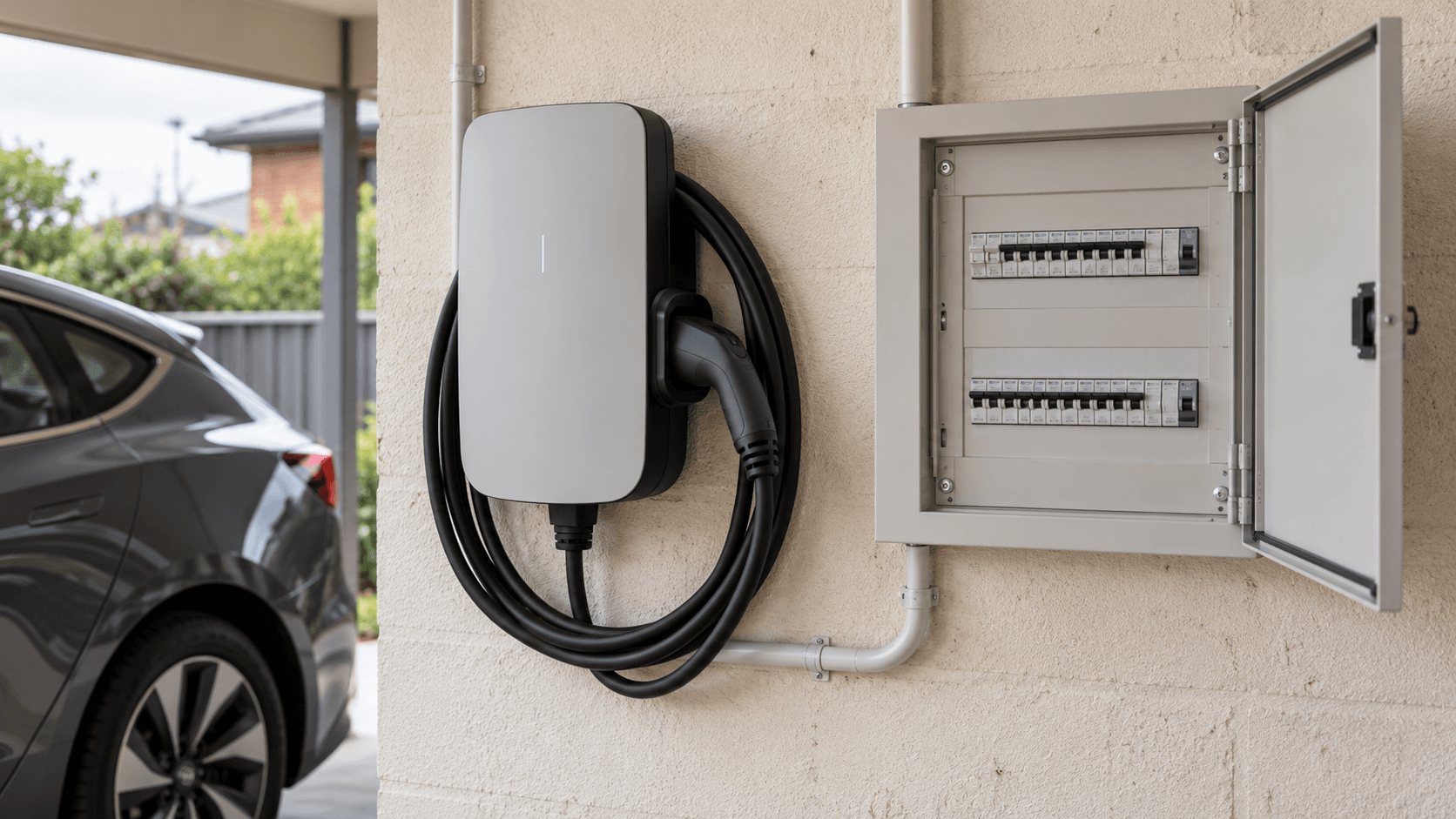
For homeowners in Glen Huntly, Caulfield, Bentleigh and surrounding Melbourne suburbs, here is how to approach that conversation without assuming an expensive upgrade is inevitable—or assuming the existing board is ready. AI-generated illustration of a home EV charger beside a residential switchboard; not a photograph of completed LDS work.
A new circuit, a switchboard upgrade and a supply upgrade are different jobs
Ask the electrician to explain which part of the installation needs work. These terms should not be used interchangeably when comparing quotes.
| Work being discussed | What to clarify in the proposal |
|---|---|
| Charger circuit | What cabling and protective equipment connect the proposed charger to the electrical installation? |
| Switchboard work | Does the board need changes to its enclosure, arrangement, protection or other equipment? What is being retained? |
| Supply-related work | Is there a constraint beyond the charger circuit or board, and does it involve the distributor or another party? |
| Charging controls | Is the charging rate fixed, scheduled or dynamically adjusted? What hardware and configuration are included? |
A new-looking switchboard does not, by itself, answer whether the proposed charger can be added. Equally, a photograph of an older board is not enough to specify the entire job. Ask what the on-site assessment found and why the recommended work is needed.
What should be assessed before EV charger installation?
LDS's EV charger installation service in Melbourne includes a load and site assessment. When requesting a proposal, make sure the discussion covers more than the charger brand.
Your vehicle and charging routine
Tell the installer your vehicle's make, model and year, approximately how much you drive, and how long the car normally stays parked at home. Mention a second EV or other electrical upgrades you are planning.
A household that can leave the car connected overnight has a different brief from one that needs a substantial top-up between short trips. Ask what charging arrangement meets your routine, rather than choosing solely by the largest advertised kW rating.
The existing electrical installation
Ask the electrician to assess the available supply and existing loads, the condition and suitability of the board, and the protection required for the particular charger. Make clear whether the quote includes any additional assessment or work that may be identified on site.
Avoid accepting a one-size-fits-all list of protective devices from an online article. The equipment and installation requirements need to be checked against the selected product and applicable electrical requirements.
Parking position and cable route
Show where you normally park and where the vehicle's charging port sits. Ask how the cable will reach it, where the charger will be mounted, and what route the electrical installation will take. A nearby wall and a suitable cable route are different things; the proposal should address both.
Only provide photos from a safe, normal viewing position. Do not remove a switchboard cover or touch internal equipment to help obtain a quote.
Can load management avoid an upgrade?
Sometimes, but it is an option to assess—not a guarantee that electrical work can be avoided.
There are different types of charging control. A fixed charging limit caps the configured rate. A schedule controls when charging happens. Dynamic load management can adjust charging as other household demand changes, when supported by the equipment and correctly installed monitoring.
For example, Tesla describes a Dynamic Power Management option for compatible Wall Connector installations that uses an approved power meter to monitor household demand and adjust the charging rate. That is a manufacturer-specific example, not a feature to assume every charger includes.
Ask these questions before relying on load management:
- Is the exact charger compatible with the proposed monitoring equipment?
- Is all required hardware included in the quote?
- What charging rate might be available while other appliances are operating?
- How will the system be commissioned and demonstrated at handover?
- What work is still required even if charging demand can be managed?
If the board or installation needs corrective work, adding a smart feature does not remove that issue. Where an upgrade is recommended, our switchboard upgrades and repairs service explains the relevant service offering.
Do you need three-phase power or a 22 kW charger?
Not automatically. Home charging should match the electricity installation, the charging equipment and the vehicle's AC charging capability.
A charger's advertised maximum is not a promise of the rate your car will receive. The vehicle's onboard charger and the installation can limit actual charging power. Ask the installer to explain the proposed rate for your specific car and supply, including whether a change to the supply is warranted for your needs.
Before agreeing to extra work for faster charging, compare what it gives you in practical terms: how much energy you normally need to replace, how long you have to charge, and whether the proposed arrangement meets that routine. Do not assume that the highest available equipment rating is the most useful choice for every home.
What should the installation quote include?
Compare the complete scope, not just the price of the charging unit. A useful written proposal should make the following points clear:
| Quote item | Question to ask |
|---|---|
| Charger | What is the exact model, and who supplies it? |
| Proposed charging setup | What rate and controls are planned for my vehicle and home? |
| Electrical work | Which circuit, board or supply-related work is included, and why? |
| Installation route | What cable route, mounting, access and finishing work are allowed for? |
| Smart features | Is load-management hardware included, or is it an extra? |
| Completion | What testing, commissioning, user demonstration and certification are included? |
| Total and exclusions | Does the quoted total include GST, and what could change the price? |
There is no reliable single price for every combination of charger, board condition and installation route. If board work is needed, the existing Melbourne switchboard upgrade cost guide provides background on pricing factors. Use a current written proposal for your property rather than treating a general guide as your installation price.
What happens after installation?
Ask for a handover that explains the configured charging settings, any app or schedule you will use, and how to obtain help if a fault occurs. Make sure any agreed load-management function has been commissioned and explained.
Energy Safe Victoria requires a Certificate of Electrical Safety for electrical installation work. Ask how and when you will receive the certificate for your job, and retain it with the installation and manufacturer documentation. Additional inspection requirements depend on the work performed.
For an existing local example, see LDS's EV charger installation project in Caulfield. It describes the installation process and switchboard checks; it is not evidence that every property needs the same equipment or upgrade.
Frequently asked questions
Can you tell from a switchboard photo whether I need an upgrade?
Photos can help start the conversation, but they do not replace an assessment of capacity, condition and the proposed installation. Take them only from a safe viewing position without opening equipment covers.
Will a smart charger definitely prevent a supply upgrade?
No. Compatible load management may help manage charging demand, but suitability depends on the existing installation, equipment and your charging needs. Necessary corrective work still needs to be addressed.
Can I charge from a normal power point instead?
A compatible portable charger and suitable power point may meet some drivers' needs. Follow the vehicle and charging-equipment instructions and have suitability assessed if unsure. Do not use extension leads or power boards for EV charging. A dedicated installed charger is a separate option to discuss with a licensed electrician.
Does a 22 kW charging unit mean my car will charge at 22 kW?
No. Actual AC charging is limited by the vehicle's onboard charger, the available installation and the configured charging rate. Check the vehicle specifications and proposed installation together.
What if I live in an apartment or shared building?
Start with the owners corporation or building manager before committing to an installation. Shared parking, electricity infrastructure and approvals need to be considered as part of the project; do not assume a house installation proposal transfers directly to an apartment.
Planning an EV charger installation in Melbourne?
LDS Air & Electrical is based in Glen Huntly and provides electrical services across Melbourne's eastern and south-eastern suburbs. Tell us your vehicle details, suburb, parking position and charging routine so we can discuss an assessment and installation proposal.
Request an EV charging assessment and quote or call 0411 232 330. The starting point is understanding your home and charging needs—not assuming a full upgrade before the installation has been assessed.